Evaluated on the SafetyChores benchmark with fragile-object and dangerous-object specifications. Cost is the safety violation metric (lower is better); SR is task success rate (higher is better).
Recent advances in end-to-end, multi-task robot policies based on transformer models have demonstrated impressive generalization to real-world embodied navigation tasks. Trained on vast datasets of simulated and real-world trajectories, these policies map multimodal observations directly to action sequences for physical execution. Despite promising real-world capabilities, these models are still data-driven and, therefore, lack explicit notions of behavioral correctness — they cannot reliably enforce complex temporal rules such as "visit the charging dock before entering the storage room, and never re-enter the kitchen once you have left it." We address this gap by introducing SafeDec, a constrained decoding framework for autoregressive, transformer-based robot navigation policies that enforces safety specifications expressed as Signal Temporal Logic (STL) formulas. Our method ensures that generated actions provably satisfy STL specifications under assumed dynamics at runtime without retraining while remaining agnostic of the underlying policy. We evaluate SafeDec on tasks from the CHORES benchmark for state-of-the-art embodied navigation policies across hundreds of procedurally generated environments and show that our decoding-time interventions are useful not only for filtering unsafe actions but also for conditional action generation.
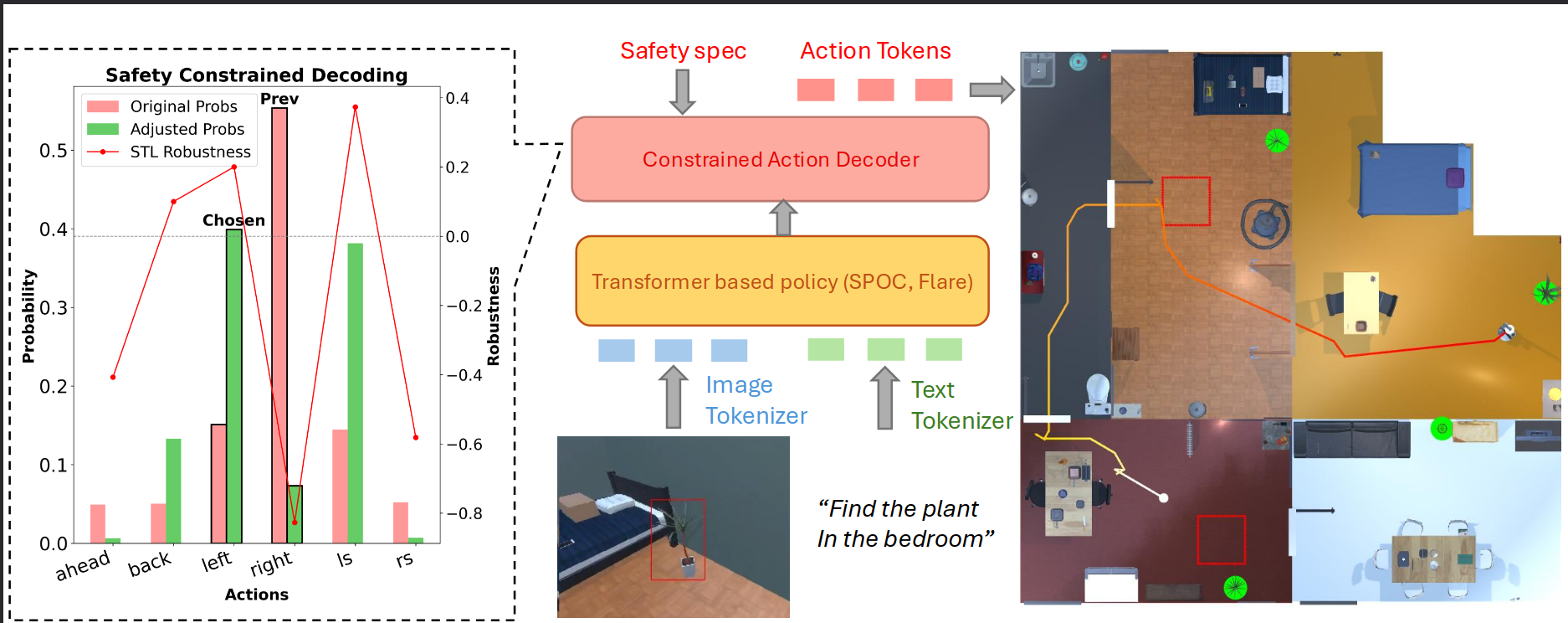
We take the constrained-decoding principle and apply it to enforce safety specifications over state trajectories. Safety rules are captured by Signal Temporal Logic (STL), a language defined over continuous signals from dynamical systems. SafeDec simulates candidate actions with an approximate dynamics model and evaluates STL satisfaction in real time, directly inside the decoding loop.
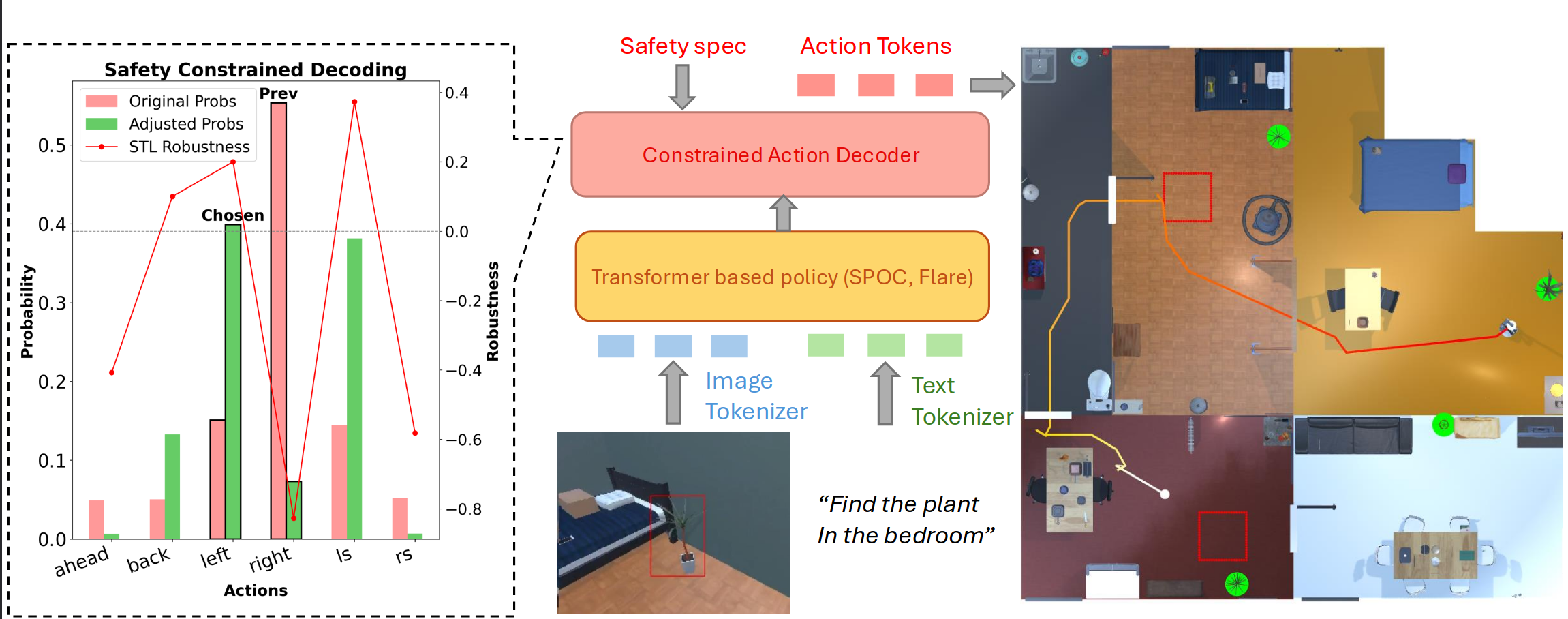
If a candidate action's predicted next state would violate the STL spec φ, set its logit to −∞ (zero probability) before softmax. This yields provable compliance under the assumed dynamics model.
Compute the STL robustness score ρ for each candidate's predicted successor state and convert it to a weight that boosts safer actions and suppresses risky ones (tunable via β). Preserves task performance while greatly reducing violations.
SafeDec is model-agnostic: it only needs (1) access to decoder logits and (2) an approximate dynamics function. STL evaluation is done efficiently via STLCG++ for real-time inference.
SafeDec is evaluated on five safety specifications expressed as STL invariants, spanning geofencing, avoidance, temporal ordering, conditional constraints, and object-interaction safety. All specifications are enforced at runtime without any retraining.
STL: G(⋀ᵢ ¬Rᵢ)
The robot must always stay outside all designated unsafe regions throughout the entire trajectory.
STL: G(⋁ᵢ Rᵢ)
The robot must always remain within at least one of the designated safe/allowed regions.
STL: G(¬R₂) ∨ (¬R₂ U R₁)
The robot must avoid region R₂ until it has first reached region R₁, or avoid R₂ forever — enforcing a temporal ordering constraint on regions.
STL: G(R₀ ⇒ G(¬R₀ ⇒ G ¬R₀))
Once the robot leaves region R₀, it may never re-enter — a conditional, one-way constraint on previously visited areas.
Specs: φfragile & φdangerous
Evaluated on the SafetyChores benchmark: the robot must respect fragile-object and dangerous-object constraints — ensuring safe interaction in household environments.
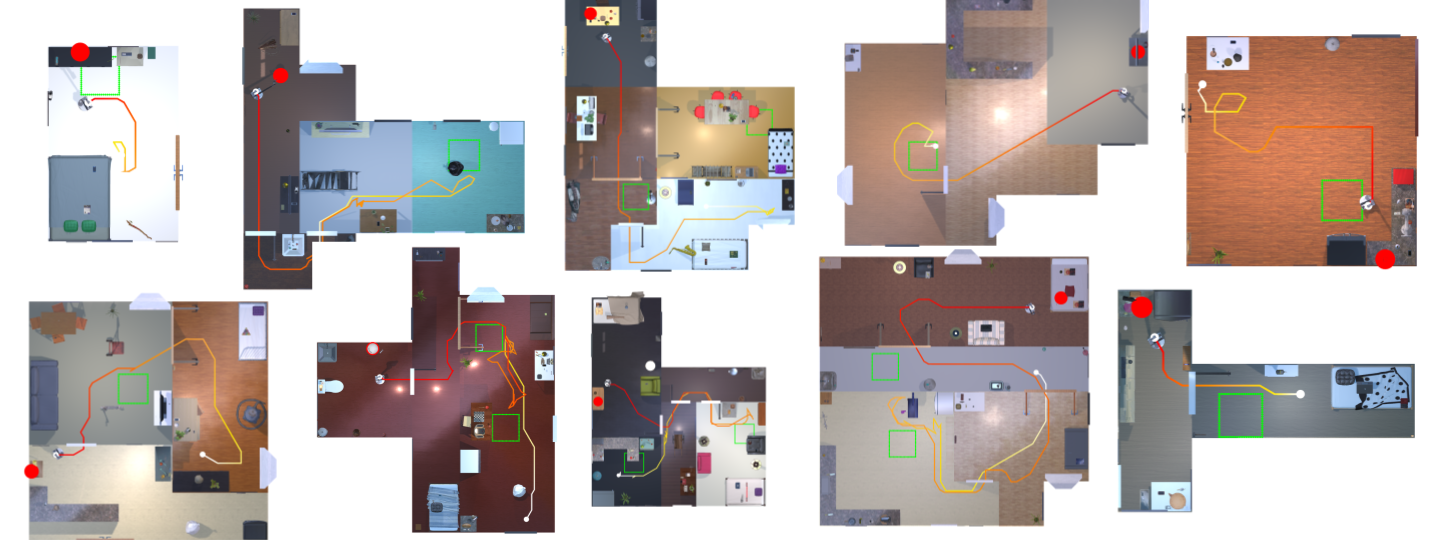
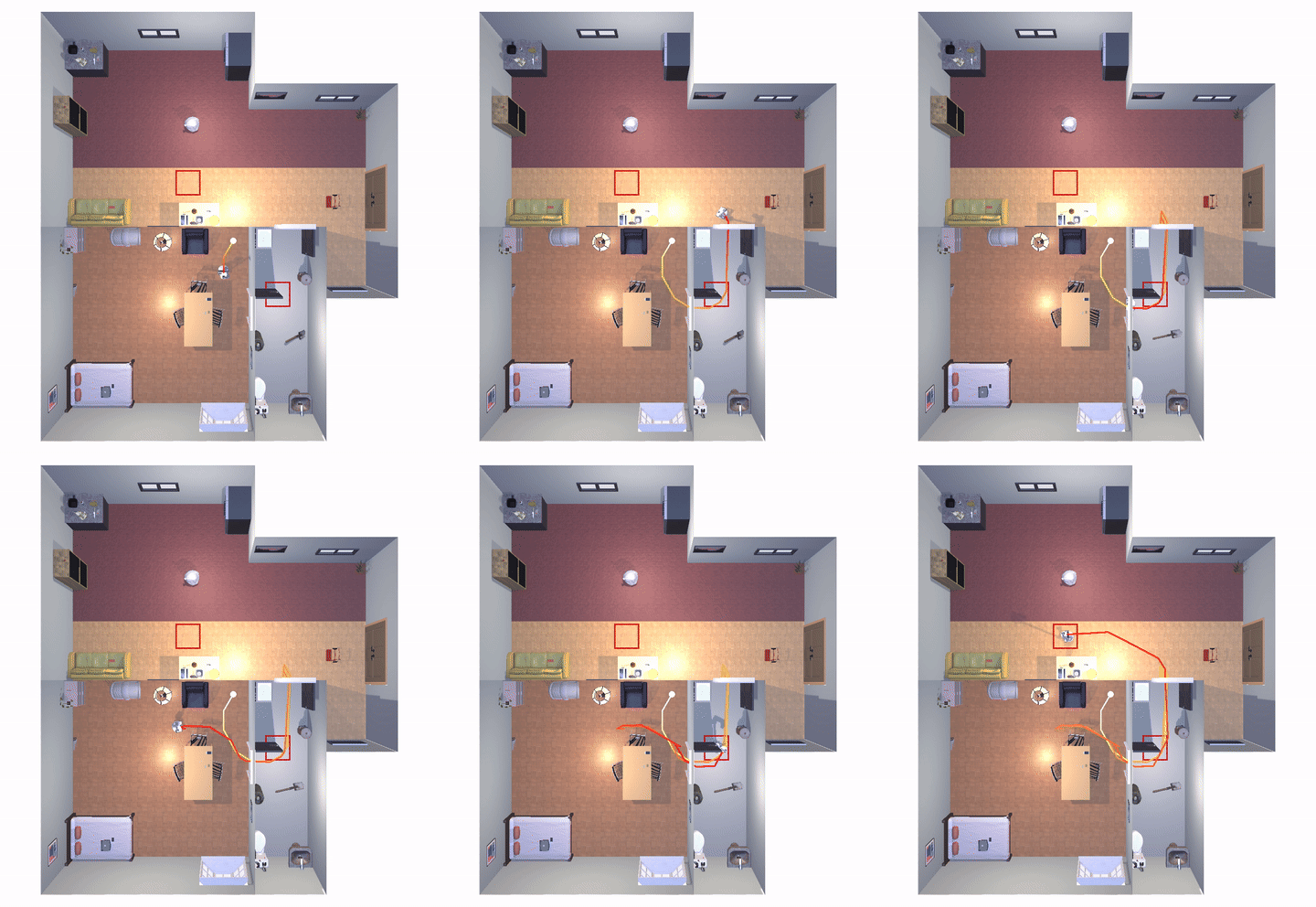
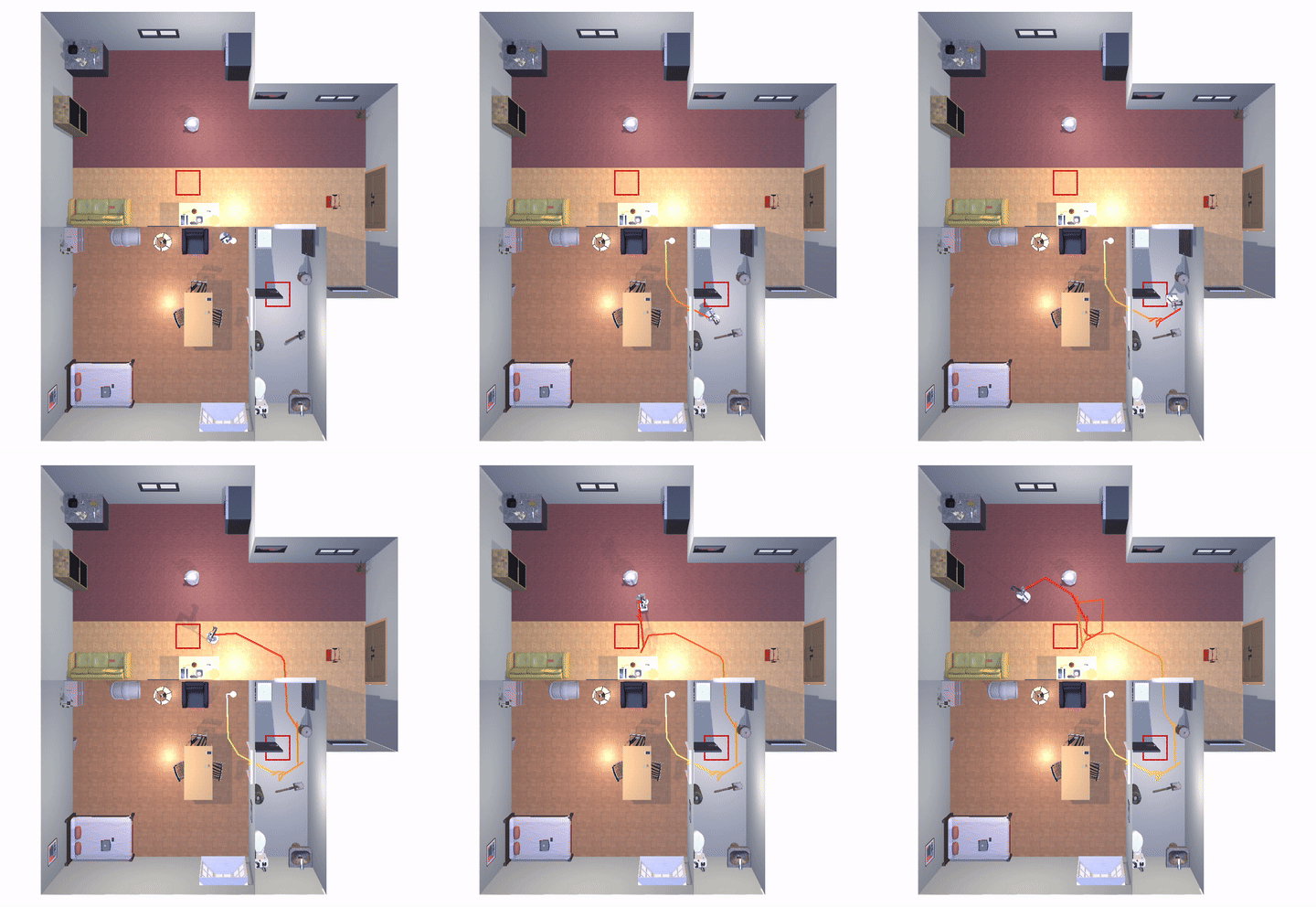
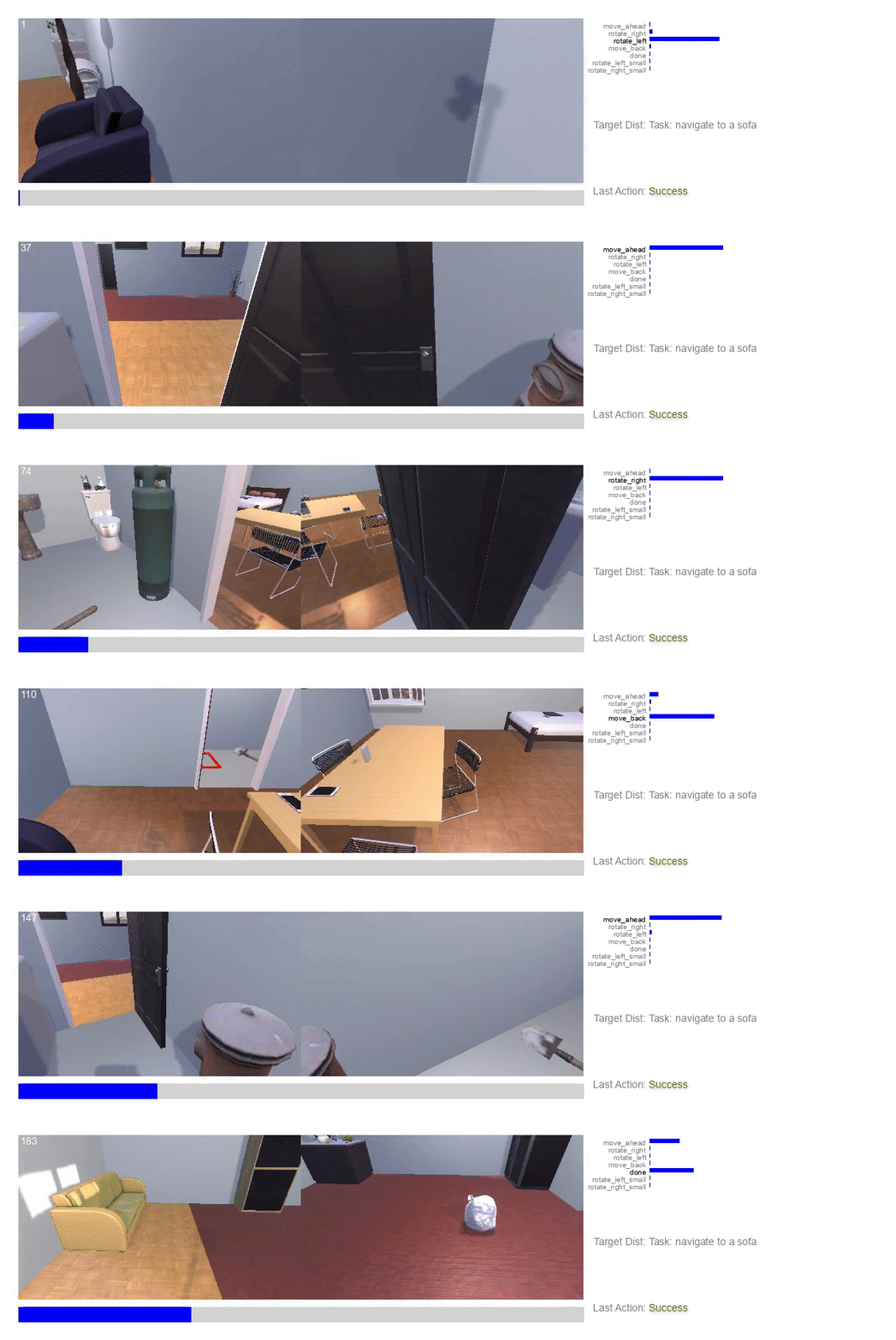
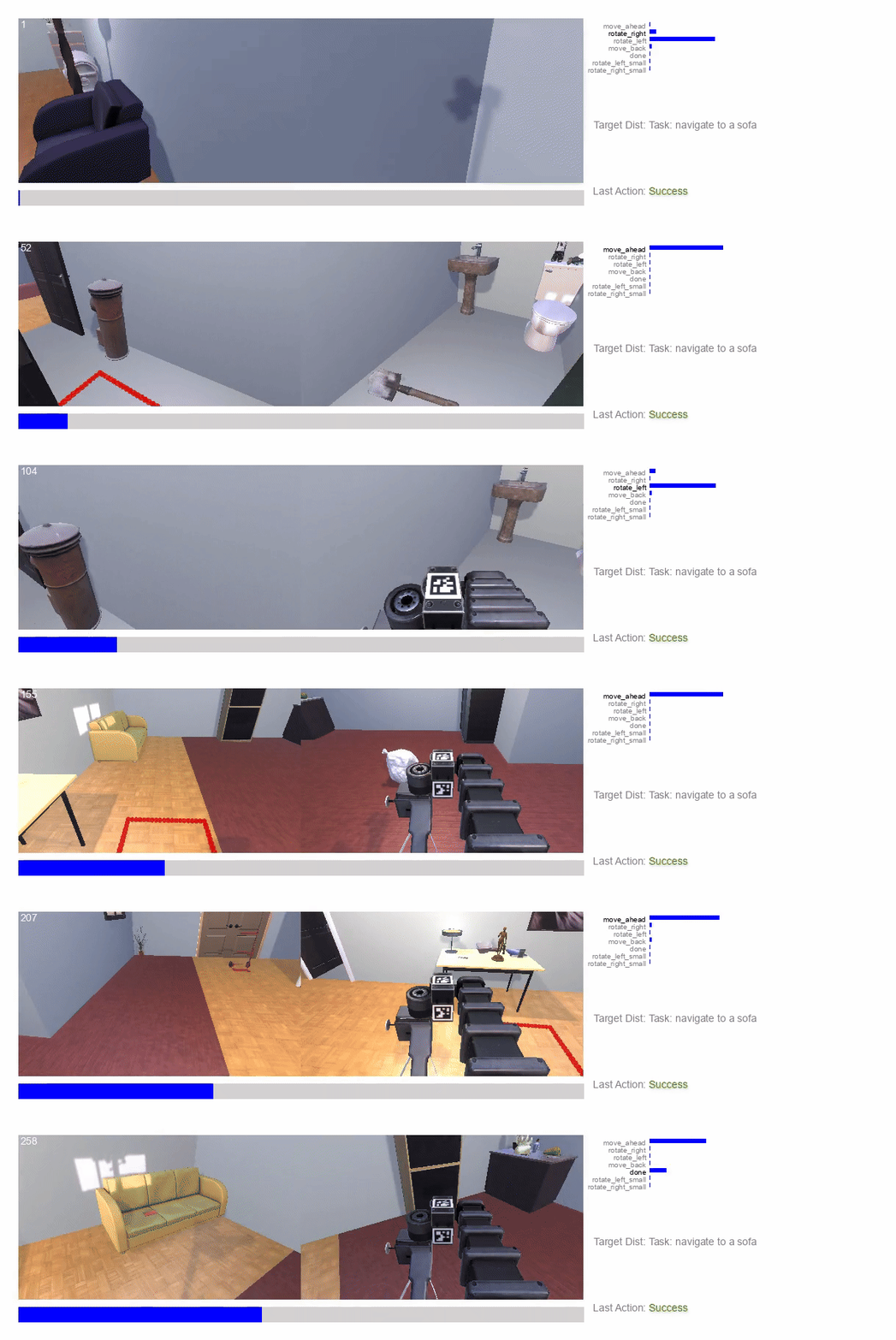
Each plot shows a bird's-eye view of trajectories starting from the white dot under the instruction "find a sofa." The unconstrained model passes through forbidden regions (red squares) on the way to the goal. SafeDec modifies the trajectories to respect STL safety specifications while still reaching the target.
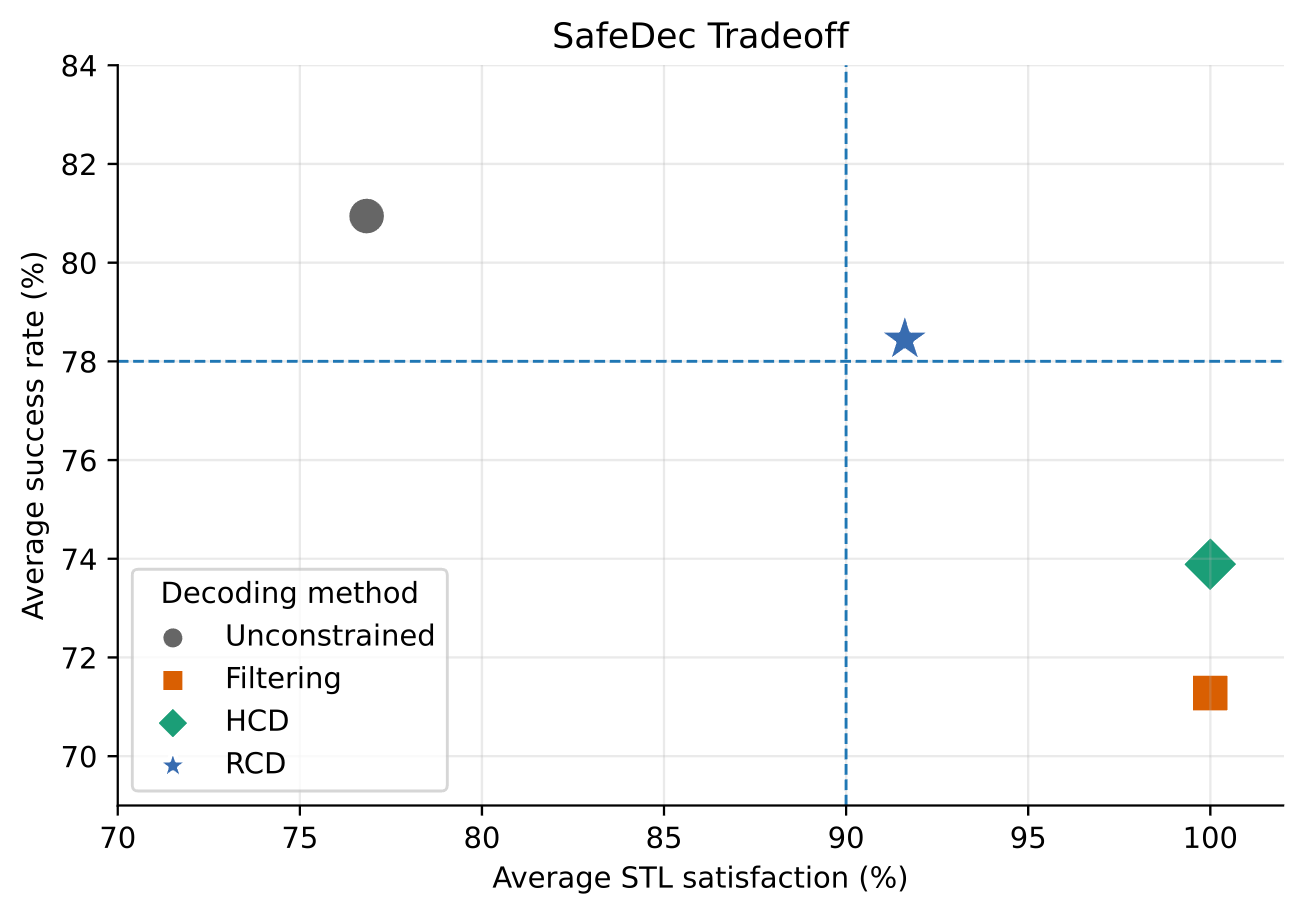
Evaluated on hundreds of procedurally generated AI2-THOR scenes with three state-of-the-art policies (SPOC, FLaRe, PoliFormer) across all five specifications. The figure below shows the average STL satisfaction vs. task success rate aggregated across all five specs and all three policies.
We evaluate SafeDec on the SafetyChores benchmark against ISA (SafeVLA), a safety-reinforcement-learning baseline trained specifically to minimize constraint violations, using fragile-object and dangerous-object STL specifications. Despite being entirely training-free, SafeDec achieves competitive task performance while dramatically reducing safety cost. Notably, pairing HCD with ISA reduces safety cost by an order of magnitude (0.205 → 0.015) with only a modest 4.5% drop in success rate.
| Method | Cost ↓ | Success Rate (%) ↑ |
|---|---|---|
| ISA (SafeVLA) | 0.205 | 86.5 |
| ISA + HCD | 0.015 | 82.0 |
| ISA + RCD | 0.060 | 86.0 |
| FLaRe | 0.192 | 82.0 |
| FLaRe + HCD | 0.115 | 84.0 |
| FLaRe + RCD | 0.155 | 79.0 |
Evaluated on the SafetyChores benchmark with fragile-object and dangerous-object specifications. Cost is the safety violation metric (lower is better); SR is task success rate (higher is better).
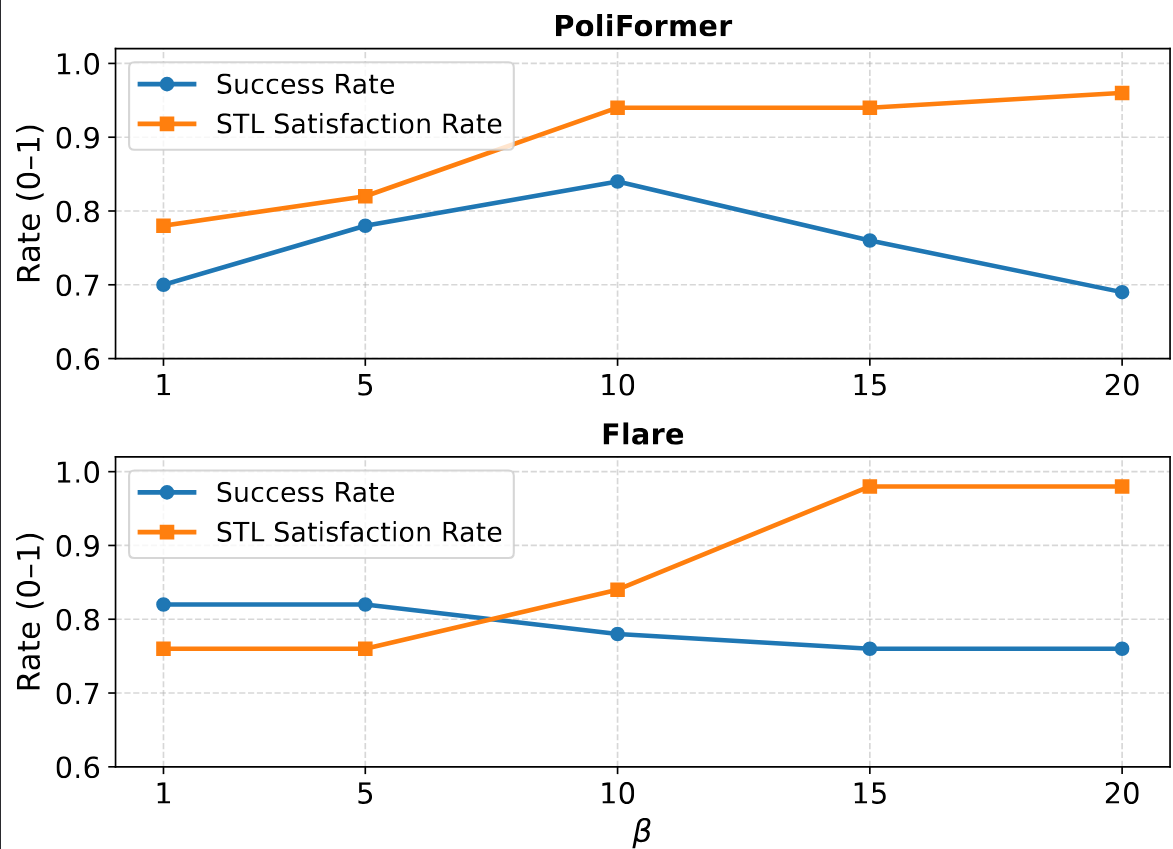
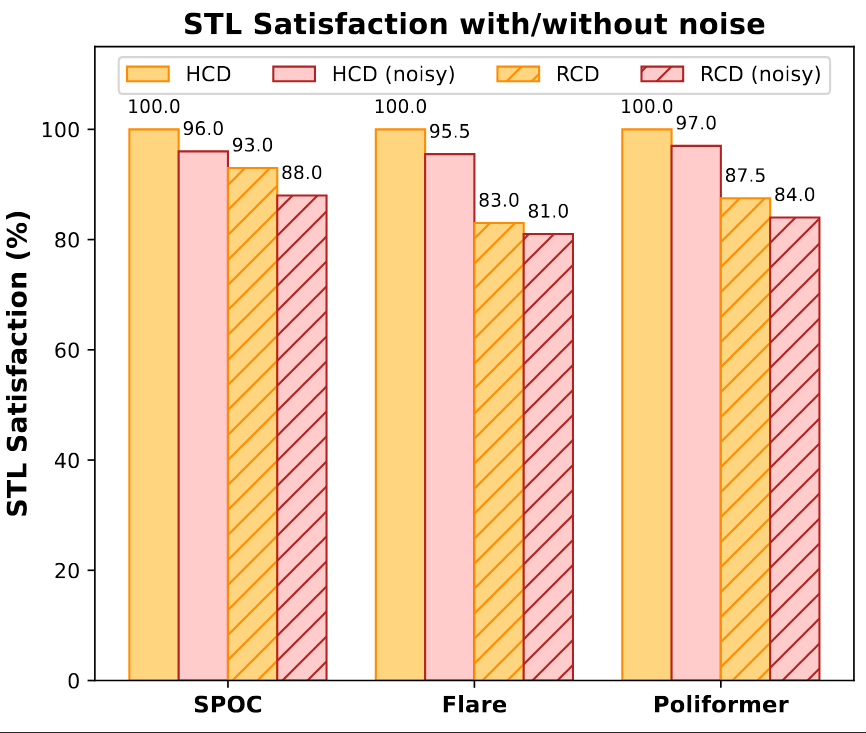
Since SafeDec assumes a simple unicycle dynamics model for state prediction, we evaluate the impact of noisy dynamics on final STL satisfaction. We also sweep over the β parameter for RCD, which controls how much specification satisfaction is prioritized over task performance.
@article{kapoor2025safedec,
title = {SafeDec: Constrained Decoding for Safe Autoregressive Generalist Robot Navigation Policies},
author = {Kapoor, Parv and Ganlath, Akila and Clifford, Michael and Liu, Changliu and Scherer, Sebastian and Kang, Eunsuk},
booktitle = {International Conference on Machine Learning (ICML)},
year = {2026}
}